Las Mujeres: The Women Behind the Day of the Dead
From La Catrina and Frida Kahlo to the women who keep memory alive at home.
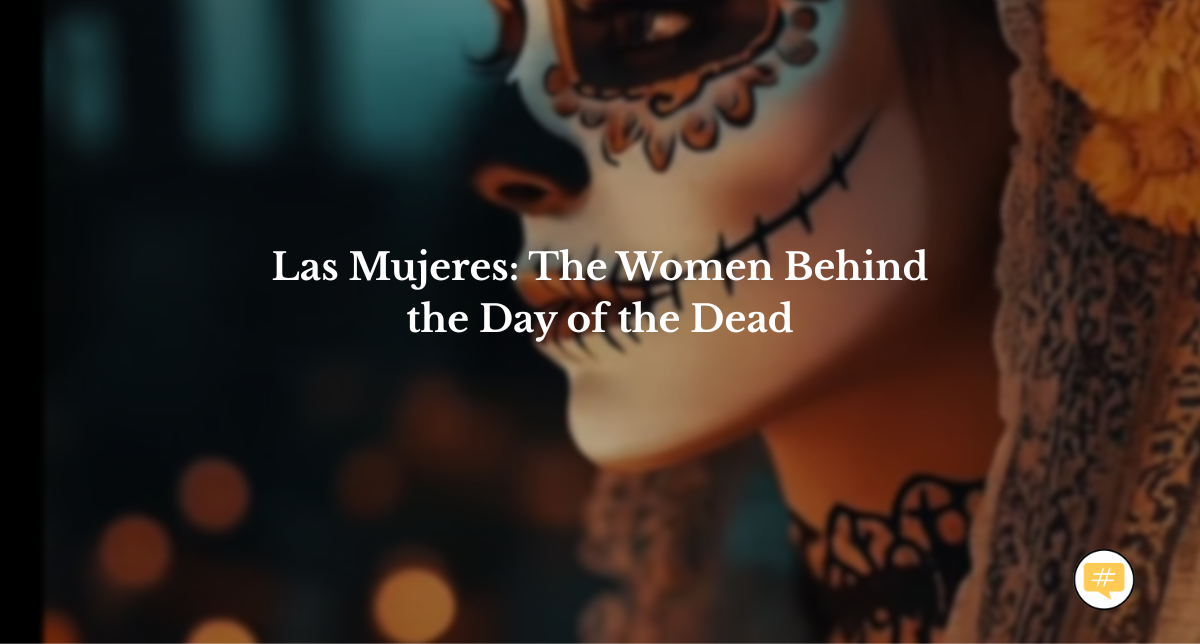
She walks through flowers and candlelight like memory itself, carrying grief, beauty, ancestry and the stories that refuse to disappear.
From La Catrina and Frida Kahlo to the women who keep memory alive at home.
Before La Catrina became one of Mexico's most recognisable women, she was a joke.
Not a goddess.
Not a patron saint.
Not even originally the exquisitely dressed skeletal woman we now see painted across faces, printed on dresses and standing among marigolds every Día de Muertos.
She began with an artist named José Guadalupe Posada and a very Mexican talent for using humour to say something much less comfortable.
This story also became a spoken-word episode of the Hustle and Glow Podcast , exploring La Catrina, Frida Kahlo, memory, women and Día de Muertos.
Listen on SpotifyThe inspiration behind La Catrina
Around the beginning of the twentieth century, Posada created La Calavera Garbancera , a skeletal figure wearing an enormous European-style hat.
She had no elaborate dress.
In fact, the contrast was the point.
The fancy hat represented status, European aspiration and performance. The exposed skeleton underneath reduced all of that pretence to bones.
Mexico's Instituto Nacional de Bellas Artes y Literatura has described Posada's figure as a satire of people who rejected Indigenous identity while attempting to present themselves as European and wealthy.
Which may be one of the most Mexican origin stories imaginable.
Then Diego Rivera gave her a body
Decades later, Diego Rivera took Posada's skeletal woman somewhere else entirely.
In 1947 he painted Sueño de una tarde dominical en la Alameda Central , or Dream of a Sunday Afternoon in Alameda Central Park.
The mural is enormous.
More than fifteen metres long and filled with figures from Mexican history, it compresses conquest, colonialism, political upheaval, revolution and modern Mexico into one strange Sunday walk through the Alameda.
And standing at its centre is La Catrina.
Rivera gave her a full body.
He dressed her as an elegant nineteenth-century woman.
On one side of her stands José Guadalupe Posada, the artist who created her.
On the other is Rivera himself, depicted as a child.
La Catrina holds the child's hand and connects herself visually to Posada.
Rivera did not bury the source.
He put the creator right beside the creation.
See the mural:
Rather than reproduce the artwork here, you can view Sueño de una tarde dominical en la Alameda Central through the Museo Mural Diego Rivera / INBAL.
Look at where Rivera put Frida
And behind the child Diego is another woman.
Frida Kahlo.
Frida is not La Catrina.
She did not create La Catrina.
But Rivera places her within this extraordinary symbolic family.
INBAL describes Frida as standing behind the nine-year-old Rivera and embracing him in a maternal gesture.
It is almost too perfect an image for what happened next culturally.
Because Frida herself would eventually become something larger than the woman who painted the paintings.
She became an international image of Mexican identity.
Flowers in the hair.
Tehuana dress.
Indigenous textiles.
Pain.
Sexuality.
Politics.
Womanhood.
A body that suffered and was still decorated.
A life that refused to become discreet.
The companion Hustle and Glow episode turns this section into a spoken-word reflection on Frida, Catrina and the female body.
Listen on SpotifyLife imitating death. Death imitating life.
Perhaps this is why La Catrina survives so beautifully inside Día de Muertos.
She is not frightening.
She is dressed.
She is decorated.
She has a hat.
Sometimes she has flowers.
Sometimes she is glamorous enough to make the living look underdressed.
Día de Muertos does something unusual with death.
It does not pretend death isn't coming.
It sets a place for it.
UNESCO describes Día de Muertos as an Indigenous Mexican festivity dedicated to the dead, with families preparing food, flowers, candles and offerings to welcome deceased relatives and loved ones back into the world of the living.
This is not Halloween.
It is not a fascination with dying.
And then there is the altar
This is where I think women enter the story in a completely different way.
Not as icons painted by famous men.
As keepers of memory.
The ofrenda is one of the central practices of Día de Muertos.
Families bring photographs.
Candles.
Water.
Food.
Flowers.
Objects belonging to the person who died.
Their favourite drink.
The bread they loved.
The sweets they would have reached for.
The things that make a person recognisable even after the person is gone.
I want to be careful about calling this universally matriarchal, because Mexican traditions vary enormously by region, class, community and family.
But I do think there is something worth examining about the labour behind memory.
Who remembers what Abuela liked to eat?
Who knows where the photograph is?
Who cooks the mole?
Who kept the scarf?
Who remembers the story about the wedding?
Who knows which flowers belonged on the table?
Who teaches the children whose photograph they are looking at?
That labour frequently lives inside families long before anybody calls it cultural preservation.
And much of that work has historically been associated with women.
Not because every Mexican family operates the same way.
But because domestic life has often been one of the places where women carry history.
The podcast goes deeper into the question behind the altar: who remembers, who keeps the stories, and who carries family history forward?
Listen to Hustle and Glow on SpotifyWomen do not only inherit culture. We curate it.
That may be the real women's story inside Día de Muertos.
It is not simply that Mexican culture has produced famous women.
It is that women have so often been responsible for making sure people are remembered.
The artists.
The mothers.
The daughters.
The grandmothers.
The aunties.
The women making food.
Cutting paper.
Finding photographs.
Telling children stories about people they never met.
The person who says:
No, put that picture there. That's the one she liked.
Add his tequila.
Your grandfather loved that bread.
Those small instructions are how a person remains in the family.
A record of women remembering women
There is a beautiful Smithsonian example involving writer Sandra Cisneros, who created an ofrenda for her mother, Elvira Cordero Cisneros.
The altar includes things that tell you who Elvira actually was.
Books.
Flowers.
Coffee.
Pastries.
Objects she collected.
A Virgin of Guadalupe image that belonged to an earlier generation of women.
It becomes not merely an altar to a dead woman, but a record of women remembering women.
That is when Día de Muertos stops being an aesthetic.
The marigolds are beautiful.
The papel picado is beautiful.
La Catrina is spectacular.
But none of those things matter very much if nobody remembers whose photograph is on the altar.
La Catrina became Mexican by refusing to stay still
Her evolution is also part of the point.
Posada's Garbancera was satire.
Rivera transformed her into the elegantly dressed Catrina and placed her inside his visual history of Mexico.
Over time she became increasingly associated with Día de Muertos and eventually one of the most internationally recognisable symbols of Mexican culture.
Culture does that.
It borrows.
It remembers.
It changes the story.
It forgets part of the origin.
Then somebody digs it back up.
Very Día de Muertos, actually.
Maybe that's why she still matters
There is an irony in what happened to La Catrina.
Posada created a woman mocking the performance of European sophistication.
Today she may be one of the most unmistakably Mexican women in the world.
She went from a warning about abandoning Mexican identity to an icon of Mexican identity.
And beside her, culturally if not historically, sits Frida Kahlo.
Another woman whose image escaped the boundaries of her own lifetime.
Frida gives us the living body in pain.
Catrina gives us the body after pain no longer matters.
Both are dressed beautifully.
Both look directly at us.
Neither appears particularly interested in making us comfortable.
Las mujeres
Maybe that is where I want to leave this story.
With the women who became icons.
And the women whose names we will never know.
The artists.
The mothers.
The daughters.
The grandmothers.
The aunties.
The women making food.
Cutting paper.
Finding photographs.
Telling children stories about people they never met.
The person who says:
No, put that picture there. That's the one she liked.
Add his tequila.
Your grandfather loved that bread.
Those small instructions are how a person remains in the family.
The altar is temporary.
The work of remembering is not.
Día de Muertos understands something many cultures spend enormous energy avoiding:
The dead remain part of who we are.
And perhaps one of the quietest forms of power women have always held is deciding which stories make it to the next generation.
La Catrina reminds us that death eventually removes the titles, money, clothes and pretence.
Frida reminds us that a life can outgrow the body that contained it.
And the women building altars at home remind us of something even more important.
That, to me, is Día de Muertos.
If you want to hear this story rather than read it, the companion podcast is a more poetic, spoken-word version of the piece.
Listen on Spotify