The Gap Paid for Its Silence with 8.2 Million People.
Here's What That Means for Your Business.
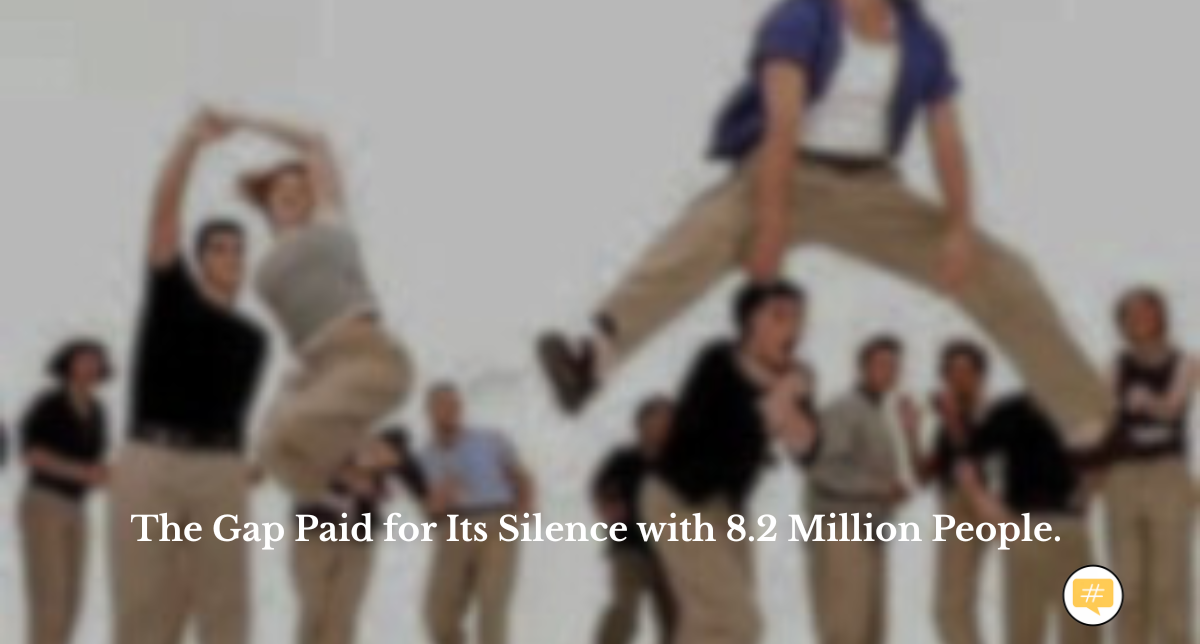
I used to fold the denim wall at the Gap at the Santa Anita mall on Sunday mornings before the store opened. I was about 19, completely obsessed with the brand, and convinced that working there was the coolest thing a person could do with a weekend. This was the 90s. The Gap was everywhere. The commercials were iconic. Khaki swing, leather, denim, celebrities mid-dance in a white studio. It was one of those brands that felt genuinely alive in the culture, not just present in a mall.
So watching it go quiet over the years has been something I have thought about a lot. Not because I have some deep nostalgic attachment to a retail chain, but because the way the Gap lost ground is the same way most businesses lose ground. Quietly. Gradually.
Without a single dramatic moment you could point to and say, that was the problem.
They did not have a scandal. They did not make a catastrophic strategic error. They just withdrew. And the culture moved on without them.
The cost of being quiet is not zero.
This is the thing I keep trying to get into boardrooms in New Zealand, and honestly, across every market I work in. Silence is not neutral. It is not a safe holding position. It is a decision with a price tag, and sometimes we do not find out what that price tag was until the receipts are already printed.
Research from Tracksuit in 2025 put a number on what happened to the Gap during one of its quiet periods. Between August 2024 and February 2025, brand awareness among consumers fell seven points. Consideration dropped twelve points. When they translated that into actual human beings, it came out to approximately 8.2 million fewer people actively thinking about the brand in that window alone.
8.2 million people who moved on. Not because they chose a competitor with a better product. Not because Gap did something wrong. Just because the brand was not in the room when decisions were being made.
That is the cost of being quiet.
Why this matters even if you are not a global retail brand.
I know what you are thinking. Francesca, I am not the Gap. I do not have 8.2 million customers to lose.
Fair. But the principle scales down perfectly.
When you go quiet on social media, when you stop showing up consistently in the spaces where your potential clients are spending time, you are not maintaining your position. You are slowly surrendering it. The algorithm does not hold your spot. Attention does not wait. People discover someone else who is showing up, who is being useful, who is in the conversation, and they start to build trust with that person instead.
I know this from personal experience, not just from watching it happen to other brands. In the last three years, I have not been as present on social media as I normally have been. And sitting with that, noticing the cost of it on my own visibility and pipeline, is actually what pushed me to build this whole April series around the topic.
Because the question I had to ask myself was the same one I am asking you now. What has the silence cost me? And is that a bill I want to keep running up?
What the comeback required.
The Gap is back. Genuinely back, not just technically operational. Their collaboration with Charli xcx on the Better in Denim campaign generated 8 billion media impressions in a single month. It made Gap the number one searched brand on TikTok. It drove 7% comparable sales growth in the following quarter, and they are now on their eighth consecutive quarter of positive comparable sales growth.
That is a real comeback. But here is the thing about comebacks. They cost more than consistency would have.
To recover the ground that silence quietly surrendered over years, they had to come back at that scale. Most businesses cannot afford to do that. Which means the smarter play is not to go quiet in the first place, and if you have already gone quiet, to start showing up again before the gap between where you are and where you need to be gets any wider.
What the Gap got right when it came back.
They went back to what had worked before. The dancing, the music, the energy. They understood that the common denominator across generations, whatever the decade, is that people respond to movement and sound and things that feel genuinely alive. And they found a collaborator who embodied that for a new audience without abandoning the brand's own history.
There is a lesson in that for anyone thinking about how to re-enter a space they have been absent from. You do not have to reinvent yourself. You just have to show up in a way that is recognisably you, updated for where the audience actually is right now.
The practical piece.
50% of consumers now discover new businesses via social media, outperforming traditional search and television in brand discovery. 83% of marketers name social media as their primary client acquisition channel. Brands investing more than 20% of their marketing budget in social report 33% higher ROI.
These are not aspirational numbers. They are describing what is already happening.
If you are still treating social media as optional, as something you will get to when things slow down or when you have better content or when you feel more ready, I want you to sit with the Gap's 8.2 million for a moment. Not to scare you. Just to make the cost feel real, because it is real, it is just usually invisible until it is not.
You do not need a perfect strategy to start. You need a first post and a reason to keep going. The 12 months after that first one are where you learn what actually works for your audience, your voice, and your offer.
Start there.
My name is Francesca Alexander.
I am the founder of Social Global Grind, a boutique marketing studio based in Auckland and Los Angeles, and the Hustle and Glow Network, a women's business community built around strategy, visibility, and growth that does not cost you your wellbeing. This piece is part of my April series on the cost of being quiet. If it landed for you, the podcast episode goes deeper.