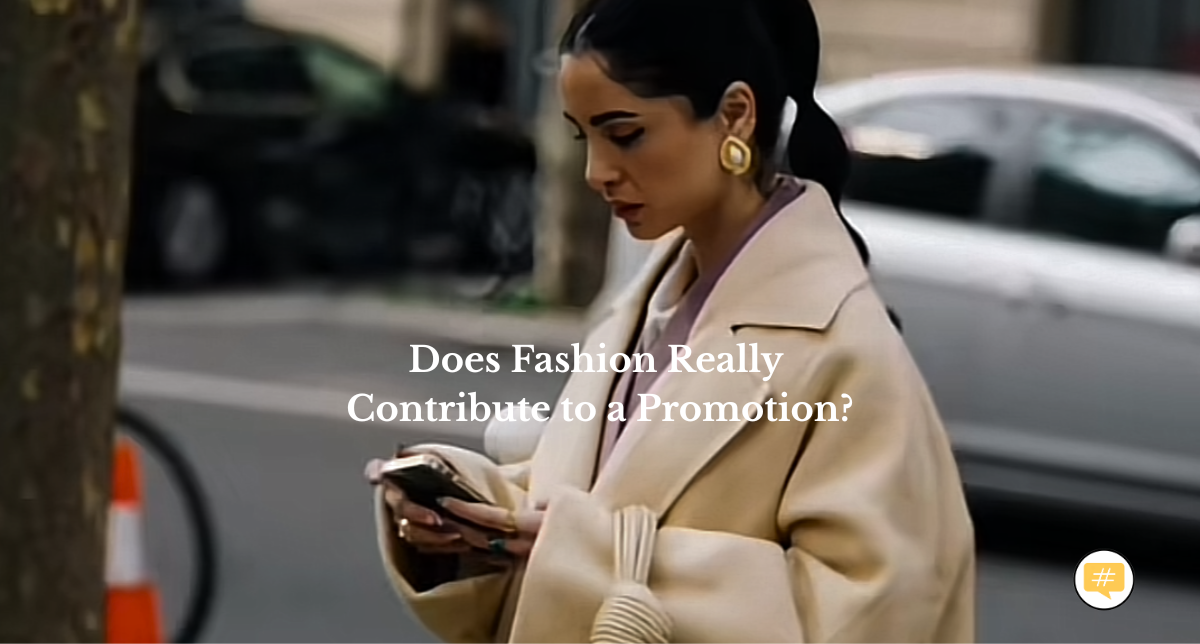
If appearance has nothing to do with getting promoted, why are women still being told to look more “senior”?
There is a phrase at work that has always made me a little suspicious:
“Executive presence.”
Sometimes it means something useful. You communicate clearly. You make decisions. You can sit in a room with senior people and not shrink.
And sometimes it feels like code.
You need more polish.
You need to look more senior.
You need to present differently.
You need to look a little more like the people we already associate with power.
Then TikTok gave us the iced coffee argument.
A recruiter with 16 years of experience posted that candidates should not arrive at interviews carrying iced coffee because, in her view, it can make the whole thing look too casual, almost like the interview is one more errand in the day. The internet immediately divided itself into the obvious camps. Some people thought this was perfectly sensible. Others thought judging someone over a latte was ridiculous.
I kept thinking about it because it is not really about coffee.
It is about signals.
Before somebody has even answered the first proper question, we are already reading the clothes, the bag, the drink, whether they look rushed, whether they look polished, whether they seem to understand the room.
That is what interests me.
Not whether the coffee is right or wrong.
The fact that a plastic cup can suddenly be made to mean something about seriousness, preparation and professionalism.
Fashion works like that too.
Clothes are doing some of the talking before you do
We read people visually.
I do not particularly like that fact, but it is a fact.
Clothes can signal money, taste, creativity, conformity, authority, whether you understand the environment and whether you want to belong in it.
Research on workplace appearance and bias has been picking at this for years. Weight bias, for example, has been found in occupational decisions involving women, including hiring and promotion. One study of 1,024 participants found bias against women at both ends of the weight continuum in hypothetical employment decisions.
That does not mean somebody got promoted because she had the better coat.
It does mean we should probably stop pretending people are evaluated in some wonderfully pure environment where only competence gets a vote.
It does not.
Women get a particularly irritating version of this
Look polished.
But effortless.
Stylish.
But not distracting.
Feminine.
But authoritative.
Attractive.
But not in a way that becomes the thing people talk about.
Good luck with that.
This is the part of workplace advice that often sounds absurd once you say it plainly.
Women are expected to understand a visual code that changes by industry, seniority, geography, culture and sometimes the personal taste of the person sitting across the table.
And yes, body size is part of it.
Research has found that weight bias can affect occupational judgments involving women, and newer reviews continue to find that heavier women can face stronger penalties in hiring and advancement decisions than men in comparable situations.
So when somebody says appearance should not matter, I agree.
When somebody says that means appearance does not matter, I think we are kidding ourselves.
“Professional” is doing a lot of work
I am probably more suspicious of the word professional than I am of fashion itself.
Who decided what that looks like?
Because knowing how to look “right” for a workplace is knowledge.
You need to know whether tailoring makes you look senior or makes you look as if you have arrived to investigate the company.
You need to know which shoes read polished and which apparently read desperate.
You need to know whether your hair, makeup, nails or lack of any of them will be noticed.
And now, apparently, whether your iced latte should have been finished in the car.
None of this appears in the job description.
Some people grow up around these codes. Some absorb them because they have worked in those environments for years. Some have somebody quietly explain them.
Others are expected to figure it out while also doing the actual job.
That is where class comes in.
And race.
Research published this year on Black women’s workplace experiences describes how hair-related microaggressions and pressure to conform to Eurocentric standards can affect belonging and advancement at work.
Calling something “professional” does not magically make it neutral.
Sometimes it just makes the rule sound respectable.
Here is the annoying bit
Sometimes changing how you dress changes how people perceive you.
I wish there were a more elegant answer.
There is not.
Most of us already know this because we behave accordingly.
We do not wear exactly the same thing everywhere.
We dress differently for different rooms.
Sometimes that is perfectly sensible.
That is what makes this conversation irritating.
Reading the room is useful.
Changing yourself until you resemble the people who already have power is something else.
And there is a lot of space between those two things.
The iced coffee debate landed there almost perfectly.
One person sees a drink.
Another sees casualness.
Another sees poor judgment.
Another sees absolutely nothing worth discussing.
Same cup.
Completely different story attached to it.
That is what we do with clothes constantly.
A quick promotion wardrobe audit
No score. I am not going to recommend a stylist when we get to the bottom.
Just answer these properly.
1. Before an important presentation, do you change what you wear because it helps you feel prepared, or because you are worried people will not take you seriously otherwise?
2. Have you ever bought something because it looked more “senior”?
3. Do you dress differently around leadership than you do around people at your own level?
4. Has anyone ever told you to look more polished, professional or executive without being able to explain exactly what they meant?
5. If your performance stayed exactly the same but your wardrobe changed significantly, do you think people at work would read you differently?
I am not interested in how many yeses you got.
I am more interested in which question made you slightly defensive.
There is probably something in that.
I am not sure fashion is the real problem
The more I sit with this, the less convinced I am that this is actually about fashion.
It is about what we decide certain things mean.
A blazer can mean authority.
A hoodie can mean genius in one industry and unserious in another.
Natural hair can become a conversation it should never have been.
An iced coffee can apparently become evidence.
The signal itself is only half the story.
The person interpreting it supplies the rest.
That is the bit workplaces need to be more honest about.
If somebody has terrible judgment, a beautiful coat will not fix it.
If somebody cannot communicate, a designer bag is not leadership training.
But if two equally capable women walk into the same room and one simply looks more familiar to the people deciding what leadership looks like, I would want somebody in that room to notice.
Because maybe we are assessing performance.
Maybe we are assessing presentation.
Maybe we are assessing whether somebody already resembles the people who have been promoted before.
Probably some mixture of all three.
That is much less satisfying than saying clothes matter or clothes do not matter.
It is also probably closer to how work actually happens.
So yes, I still think fashion contributes to how people are read at work.
I just do not think fashion is the whole story.
And the next time somebody tells a woman she needs more “executive presence,” I would quite like them to explain exactly what they mean.
Preferably before she goes shopping.
Sources and Further Reading
The current iced coffee debate followed a TikTok from recruiter Caitlin Wehniainen, who argued that bringing iced coffee into an interview can appear overly casual. Responses from recruiters, career experts and job seekers have ranged from agreement to outright dismissal of the idea as irrelevant to candidate ability. Read more at Inc.
Research on occupational weight bias has found evidence that body size can influence hypothetical hiring and promotion decisions involving women. Read the study on PubMed.
A recent systematic review found particularly strong evidence of weight stigma affecting women in hiring and advancement contexts. Read the review.
Research published in the Journal of Applied Psychology examines hair-related microaggressions and the ways natural-hair bias can shape Black women’s workplace experiences and sense of inclusion. Read the study on PubMed.
Francesca Alexander is the founder of The Intelligent Marketing Studio at Social Global Grind and the Hustle and Glow Network, a business community for founders building with intention across Auckland, New Zealand and Los Angeles, California. She hosts the Hustle and Glow Podcast, a long-form conversation series on marketing, identity, community and what it actually takes to build something real. Find her work at socialglobalgrind.com and join the community at hustleandglow.com and linkin.bio/francescahustles.